I’ve studied a language in Duolingo nearly 500 days in a row. My solved Wordle streak is in the low hundreds. I’ve closed the rings on my Apple Watch every day for a bajillion years, roughly. I’ve solved LinkedIn’s Patches puzzle 174 consecutive days.
I hate streaks.
I have a few different games on the web and in app form. I know registered users’ streaks. The data’s sitting right there in the database. But I don’t surface them anywhere.

Streaks are evil. They’re evil because they work. I do Duolingo every damn day so that I don’t lose my streak, and there are times I absolutely don’t want to do Duolingo. I hate that I’m doing it as I do it, I hate that the streak conceit is having its desired psychological effect upon me, and yet there I sit, practicing more French.
I’d love to tell you that I’m just weak-willed and that you, dear reader, are made of sterner stuff. But the research suggests we’re all equally lemming-like in this way.
Jackie Silverman and Alixandra Barasch published a paper in the Journal of Consumer Research in 2023 called “On or Off Track: How (Broken) Streaks Affect Consumer Decisions.” Across seven studies, they found that simply showing people an intact streak made them more likely to keep doing the thing — and that this effect had nothing to do with how much they’d actually done the thing. It depended entirely on how the behavior was displayed in the log.
Their explanation is the part that, frankly, sucks: People come to treat maintaining the streak as a meaningful goal in and of itself. Not learning French. Not exercising. The number.
(This is why Duolingo is happy to offer Streak Freezes. It’s incredibly defeating to see your hundreds-day-long streak reset to zero… So the app fights never to let that happen, unless you go a really long time without using it.)
I’m not a scientist, but my read of the study is that far too often, I’m not practicing French; I’m incrementing a counter for the goal of incrementing the counter. There are absolutely days where the lesson I pick is the shortest one I can find. (Often “Words.”)
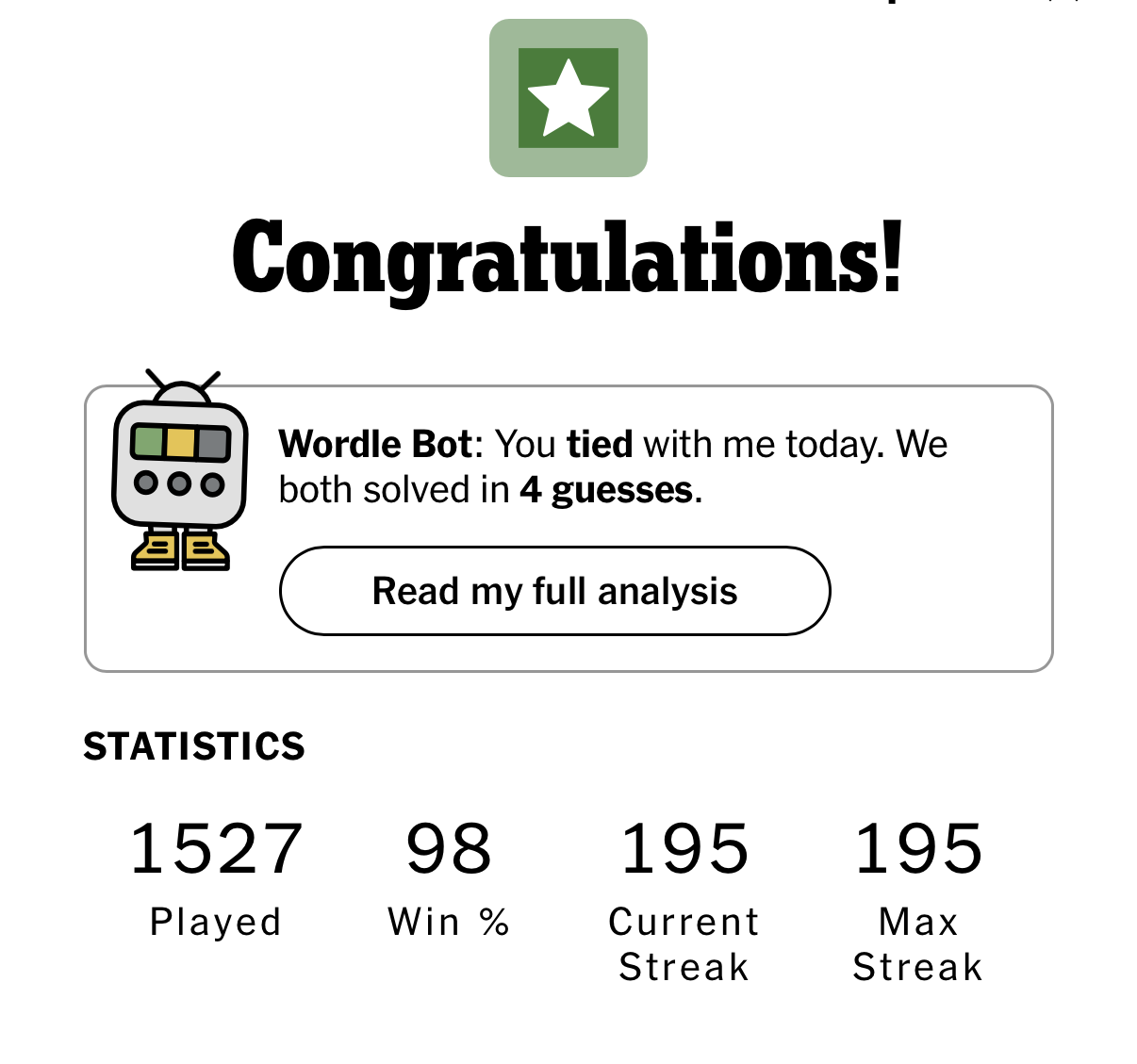
I’m not trying to get better at anything. I’m trying to not be the guy who let a 500-day streak die on a Tuesday because he was tired. (Is that guy worse than the guy who does a few perfunctory minutes of French he won’t remember? Reader, we all know the answer, and trust that I absolutely do the perfunctory few minutes anyway.)
The flip side is just as well-documented, and just as insidious. Silverman and Barasch found that a broken streak is demotivating out of proportion to what was actually missed. Skip one day and you’ve failed twice: once at the behavior, and once at the streak. People are so attached to streaks that they’ll complain to companies when a bug wipes one out and lobby to get it restored. Meanwhile, the researchers found the demotivating effect of a broken streak shrinks when you’re allowed to repair it.
Which brings us to the owl. Duolingo doesn’t sell streak freezes and streak repairs because it’s kind. Again, it offers them because the research says a broken streak makes you quit, and a quitter doesn’t pay for Super Duolingo. The freeze is a product designed to protect a number that the product itself convinced you to care about. That’s a clever business. It’s also gross.
None of this is new psychology, either. Daniel Kahneman and Amos Tversky’s work on loss aversion established decades ago that losing something hurts roughly twice as much as gaining the equivalent thing feels good. I couldn’t come up with a better way to frame that sentence, so read it again if it didn’t make sense.
Okay, fine, here’s a rewrite: Losing something hurts twice as much as winning that thing feels good.
A streak is a loss-aversion machine you carry in your pocket. Every day you extend it, it gets a little more painful to lose, which is exactly why day 500 is harder to skip than day five. Apps with streaks aren’t building habits. They’re building hostages.
And look, I get the counterargument. I am theoretically at least a bit better at French than I was 500 days ago. My rings are closed, and closed rings mostly mean I moved my body. Streaks arguably got me to show up on days I otherwise wouldn’t have. Ends and means and all that.
But I don’t think the ends justify the means, for two reasons. First, the streak optimizes for the minimum. It doesn’t care whether you did a good lesson or a good workout; it cares whether you did any lesson or a workout. Over enough days, you learn to feed it the minimum, and the minimum becomes the habit.
Second, and perhaps more importantly, I don’t like how it feels. I don’t like the small dread at 10:30 p.m. when I realize I haven’t done my French yet. I don’t like that a game I ostensibly play for fun has a mechanic whose entire purpose is to make not playing one day feel bad. Fun shouldn’t have a late fee.
So: My games. I know how many days in a row you’ve played, say, Conlextions. I could put a little flame icon next to it. I could send you a push notification at 9 p.m. that says your Conlextions puzzle solving streak is in danger. I’m confident that doing so would increase my daily active users, because the research says it would because I’m my own goddamn guinea pig and I see it work on me every freaking day.
I’m not going to do it. If you want to play one of my games every day, I’m delighted. If you want to play it every day for a month and then forget it exists for six weeks and then come back, I’m also delighted, and I’d rather you come back without feeling like you have to apologize to the app. I want you to play because you want to play. I make games, not leashes.
That’s probably costing me some engagement. I’m okay with that.
I haven’t done my Duolingo yet today. I’d like to promise you that I’m going to skip today just to stick it to the man, and the psychology. But I guarantee you I’ll do it before I go to bed.