It’s long past time Apple stop approaching support for third-party iOS app stores only when forced, while complaining about it the whole time.
Apple only allows the App Store for iOS in the US. But various countries have issued rulings requiring that Apple offer third-party app store support.
As of October 22, 2026, there are 29 countries where Apple permits third-party iPhone app stores — because it’s forced to by regulatory requirements. Now, in Australia, a court ordered Apple to allow such stores starting in 2027.
Apple says it will appeal. In fact, Apple told Reuters:
“We will request a stay and appeal the outcome to seek a resolution that respects our intellectual property and protects the safe, secure experience that consumers and developers expect from the App Store.”
Baloney. Consumers and developers want freedom to install whatever they want on their iPhones.
We’re up to 30 countries with an implemented requirement or a court order requiring Apple allow precisely this: Besides Australia, there’s the European Union, Japan, and Brazil. (It’s worth noting that Russia has also required that Apple support third-party app stores; Apple has thus far refused to comply.)
Apple’s claims haven’t held
Apple fights against needing to implement iOS app sources that aren’t the official App Store by claiming such apps are a security risk. Riley Testut has disproved those claims pretty well; AltStore hasn’t had any such issues.
The Mac obviously supports apps from outside the Mac App Store. I, for one, don’t bother putting most of my Mac apps in the App Store; I’d rather release them directly and not worry about Apple’s approval process.
And my Mac is doing just fine. So is yours. It has been just fine for decades. Nobody at Apple argues that your MacBook is a security nightmare because you can download an app from a developer’s website. The company just quietly accepts that we can be trusted with our own computers, and then insists that your iPhone is somehow totally different. You’ve probably seen the warning Apple pops up when you open a non-Mac App Store app, when your Mac asks, essentially, Are you sure about this? You say yes, you move on.
The argument Apple won’t make out loud
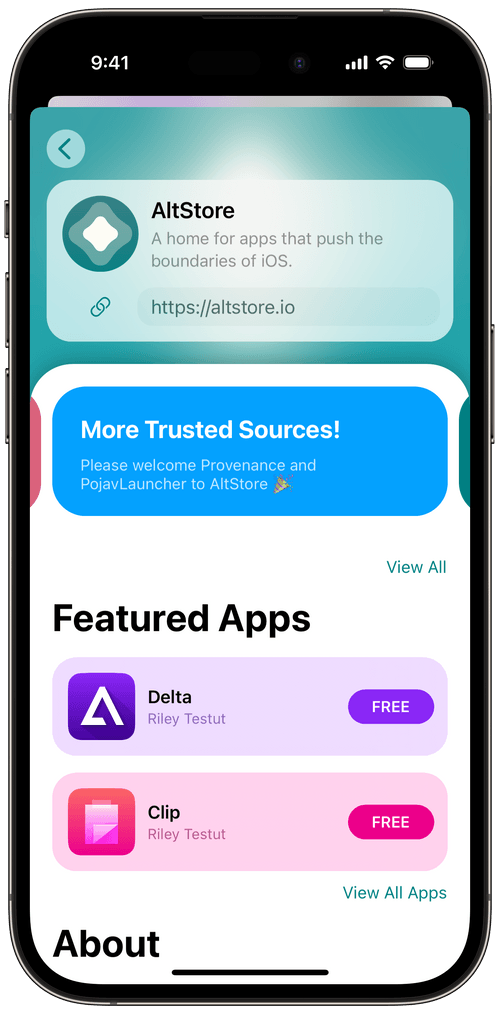
Apple’s real objection, of course, is money. Every app that ships outside the App Store is a transaction Apple never gets a cut of. I get it. It’s rude to count other people’s money, I guess, but Apple’s doing just fine. Regardless, “we’d rather keep the money” is a business preference, not a safety argument, and dressing it up as one has earned Apple nothing except a growing list of regulators and judges who stopped believing it — and a slew of frustrated developers… along with customers who could get more. (Riley’s AltStore has a true iOS clipboard manager called Clip. An App Store app can’t offer that, because of Apple’s sandboxing rules. I want an iOS clipboard manager! If Apple wants to warn me about using one, fine! I still want it!)
Apple willfully ignores the obvious reality that the App Store would “win” anyway. It’s preinstalled. People trust it. Most iPhone owners will never go looking for an alternative store — unless an app gets huge mainstream attention. And if it’s the kind of app Apple doesn’t want, Apple still shouldn’t police what its users can install of their own free will.
Look at what’s actually popular in AltStore in Europe: a game emulator, a clipboard manager, a utility for jailbreaking your e-scooter. Those apps aren’t a threat to Apple’s business.
Apple is building third-party app store support country by country, under protest, with a different set of rules in each place, and appealing every ruling along the way. They are frustrating developers, and in some cases users, and in many places — governments. This is the most expensive and painful way possible for Apple to support these stores that it seems it will inevitably need to support in more and more places.
One global policy would be simpler to build, simpler to explain, and simpler to live with — for Apple, for developers, and for the customers who’d like to know what their iPhone can do regardless of what country they’re in.
Build it once, build it everywhere
So, Apple: Quit it. Stop making courts force your corporate hand on this front. Open the iPhone to third-party app stores everywhere, on your own terms, with the notarization you already do in the EU, and then go back to making the App Store the place developers want to be, rather than the only place they’re allowed to be.
Riley told me that when Apple finally stopped treating AltStore as an enemy, it started feeling like a partner. The developers who love this platform most, with the biggest and most creative ideas, are the ones Apple keeps fighting. It could stop. It should have stopped a long time ago. The best time to allow third-party app stores and legitimate side loading was years ago. The second best time is right now.