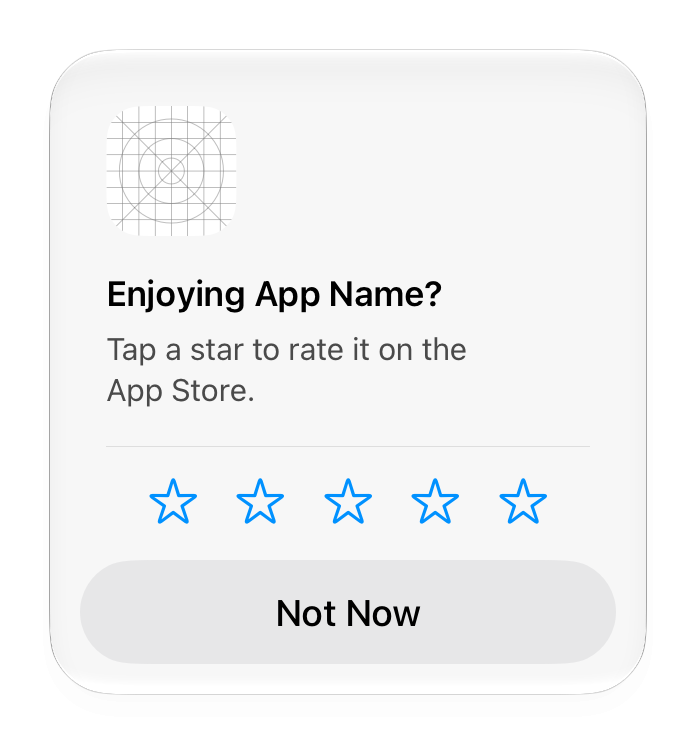
Apple offers iOS app developers a mechanism to ask users to rate and review their apps — within the apps themselves. It’s called StoreKit’s requestReview API. The developer essentially asks iOS to show the rating/review prompt at a given moment, and the system decides whether to display it or not. Apple limits how often the prompt can appear and may suppress it for other reasons, so developers can’t assume that calling the API will result in a prompt being shown.
Users hate these prompts. John Gruber hates these prompts. Though Gruber’s distaste is nuanced. In his followup to that aforelinked post, John wrote:
[T]o be competitive, apps need to do the wrong thing. I’m a competitive bastard. If I had an app in the App Store today, I’d probably prompt for reviews. I don’t begrudge developers who do it today. That’s the game. I admire developers who refuse to play this part of the game. It’s noble. But it’s not a winning strategy. I want Apple to fix the game — that’s the only real solution.
At this writing, I have six apps in the iOS App Store. My first app, Lex.Games, has 306 ratings and a 4.9 star average. (This is not a humblebrag. It’s just a fact. And a regular brag.)
My other app ratings break down like this:
LexShell (which, admittedly, is less than a month old): 5 stars, 2 ratings
Gimme a Second: 5 stars, 2 ratings
Gnome: 4.7 stars, 9 ratings
Tile & Error: 4.7 stars, 15 ratings
Cryptograms by Lex.Games: 5 stars, 6 ratings
I didn’t normalize for app installs. I don’t think it would change the fundamental point I’m making here which is: Just two of my apps break double-digits in ratings quantity, and they’re the only two that prompt users to rate.
I gave a lot of thought on when to prompt. In Lex.Games, the prompt only shows up after you solved five puzzles. That tells me you use the app a decent amount, and ideally you’re in a good mood because you just solved a puzzle.
But I’m lying. Lex.Games used to do that. I started getting a lot of ratings of either 1-star or 4-stars, saying they loved the app but hated that it asked for reviews. I can do math. I had enough great star ratings that it didn’t feel like there was any upside to continuing to ask for more reviews. So I stopped.
But like John wrote: This situation sucks, and it’s Apple’s to fix.
Plentiful reviews are a great sign that an app is good. I have no qualms about installing an app that has four or more stars, and I’m especially reassured when it has a couple hundred reviews.
It’s borderline impossible for a developer to get that number of reviews without begging users for them.
I don’t know what the ideal solution is. Amazon’s reviews are often gamed, and Amazon gets plenty of things wrong, but they do one thing quite well: They note when an item is frequently kept or frequently returned. Maybe a line like Most users keep this app installed or Often in the top-ten most-used apps on user devices or Most users launch the app 4-5 days per week or something could help. (This would obviously have to be aggregated and anonymized and opt-in. We love privacy.)
Uber drivers, eBay sellers, and App Store developers can be ruined by bad average ratings. In some ways, that’s good; we want to be warned about bad actors, and we love reassurance about good ones. But if we can’t build good reputations without annoying our customers, that’s a pretty serious problem.