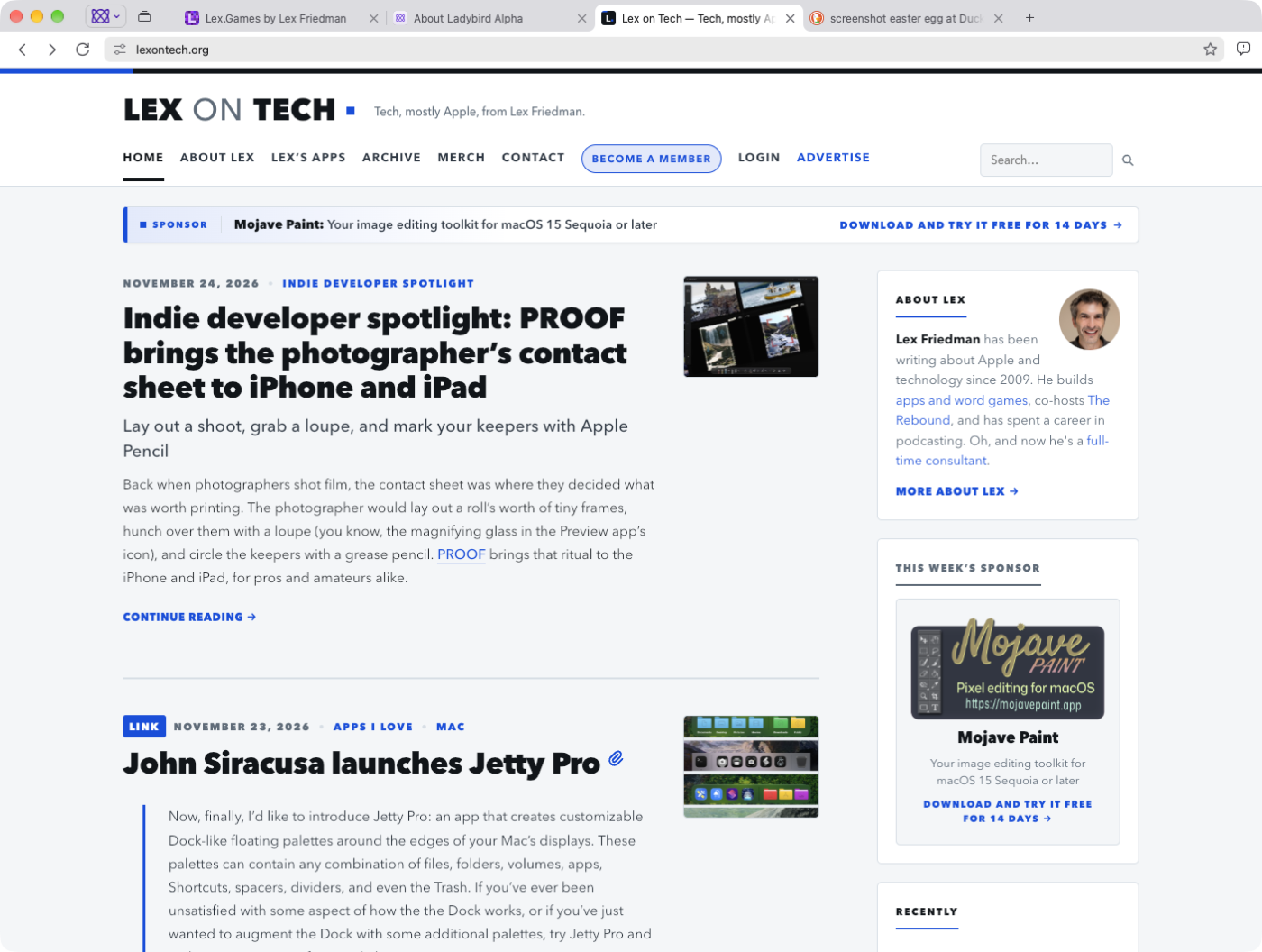
I’m leaving this piece here since I wrote it, but removing the Ladybird link. And I no longer feel the enthusiasm shared below. Thanks to a couple readers who pointed me here. I’ve changed the headline, removed a link, and am disappointed in the world again.
I wasn’t going to write about Ladybird, a new, independent web browser and rendering engine available for macOS and Linux. But then I tried it. I am incredibly impressed. So I’m writing about it.
First, some definitions:
A browser engine is the code that takes HTML and CSS, the languages that power the web, and makes it look pretty in your web browser. “This is <strong>in bold</strong>” looks like “This is in bold” thanks to the rendering engine of whatever browser you’re using right now.
The first widely popular graphical web browser was Mosaic. Then came Netscape. Microsoft’s Internet Explorer introduced its Trident rendering engine in 1997. Mozilla developed Gecko, which eventually powered Firefox. KDE — an open-source software project — developed KHTML.
Apple forked KHTML to create WebKit, the browser engine that powers Safari. Google launched its Chrome browser with WebKit, but then forked WebKit to create Blink. Microsoft forked Trident to create EdgeHTML to power its Edge browser, and then five years later abandoned its own rendering engine in favor of using Blink.
More than 90% of web browsing today happens in Chrome, Safari, and Edge. That means most web browsing is rendered by Blink and WebKit. Both are open source, but one is primarily developed by Google, the other by Apple. (Other browsers like Opera, Brave, and Vivaldi all use Google’s Blink, too, though on iOS, most browsers use WebKit regardless of who makes them.)
Ladybird in action
Firefox still uses Gecko, but accounts for only a tiny percentage of web browsing today.
Which brings us back to Ladybird.
It’s a new browser engine, built from the ground up, by a 501(c)(3) non-profit organization. Ladybird’s stated goal is “to create an independent, fast and secure browser that respects user privacy and fosters an open web.”
I downloaded the alpha because I was curious how well an entirely new rendering engine could handle the modern web. The answer is: surprisingly well. Though I saw a (very) tiny handful of similarly tiny rendering issues, for the most part, everything looks right.
This is still alpha software, and I wouldn’t recommend relying on Ladybird as your everyday browser just yet, particularly given that its security hasn’t been established.
The mindset behind Ladybird appears to be that the browser and its rendering engine are “free from conflicts of interest.” Apple gets an eye-watering amount of money from Google to use it as Safari’s default search engine — $20 billion in 2022 alone. (A federal judge ruled last year that those payments can continue, so long as the deal isn’t exclusive; both Google and the Justice Department are appealing.) Google has a vested interest in capturing as much web traffic as it can. Both Apple and Google are massive, public, for-profit businesses with obligations to their shareholders. Ladybird has no such obligations.
My initial reaction on seeing Ladybird’s launch was to think to myself, “How cute, how quaint, how useless.” Because it’s hard for me to imagine a world where a new, independent rendering engine gets traction. Update: And now I’m rooting for one to succeed… just not this one.