We need to talk about subscriptions. Many of your favorite apps now offer them. Some of Apple’s apps now offer them. Most of my own damn apps offer them.
We hate subscriptions. Okay, maybe you don’t, but most of us do. I know I often get annoyed at subscriptions. I think there are a few core reasons behind our distaste for paying for software with subscription fees:
- Many subscription models are based on deceit. In our minds, the primary goal of most subscriptions is that you pay for the subscription, forget that you’re paying for it, and keep paying for it for a long time. This is the gym membership model. Streaming music and video services hope you keep your subscription, but you save them a lot of money if you never bother to stream anything. We are angsty about subscriptions because we don’t want to keep paying for them if we’re not getting value from them. Makes sense.
- We tend to prefer owning things. If I buy an app for $5, it’s mine. If it’s $5/month, it’s not really mine the same way. I’m leasing it. That feels off.
- It’s a change. Used to be, you bought apps, and that was it. Subscribing to apps is a newer innovation, and it feels like it costs us way more than just buying software once did.
There’s some truth to that last one, sort of — though some apps used to be awfully pricey, if I recall. When Aldus launched PageMaker in 1985, it cost $495. (That’s roughly $1500 in 2026 dollars.) Upgrades to PageMaker were considerably cheaper — roughly $80 to $100 every couple of years when a new version came out. (You could, of course, keep using your older version as long as it kept working.)
Adobe Photoshop cost $895 when it went on sale in 1990 (roughly $2200 or so in 2026 dollars). The standalone version cost $699 in 2012, and upgrades cost around $200 — again, if you didn’t stick with the prior version(s) for as long as you could.
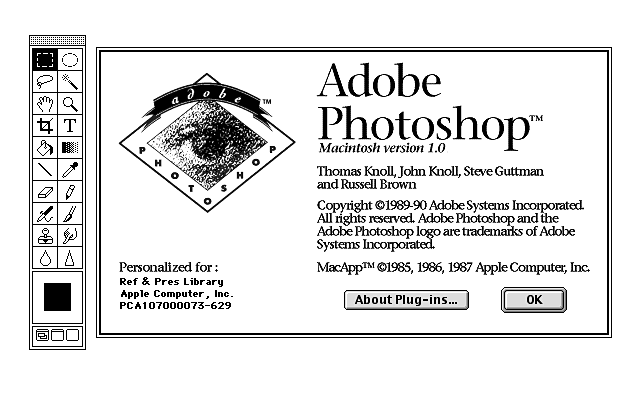
Today, you can’t buy PageMaker (because it doesn’t exist). You can’t buy Photoshop, even though it does exist, because it’s subscription only. It’s $23 per month, or slightly less if you pay for a year at a time.
This isn’t an apples-to-apples comparison, I grant you: While $699 in 2026 dollars would buy you 2.5 years of Photoshop, if you stop paying, you stop having Photoshop. That’s not how it worked when you paid for Photoshop outright.
But the upshot remains: Software is largely cheaper than it ever was, but the ownership model has fundamentally changed.
Shareware had fair fares
This holds true for games as well. Shareware games in the 1990s cost around $15. Maelstrom was $15 (and Maelstrom was a perfect game). You paid $15, and you owned it.
Shareware was generous, but it wasn’t built around the idea that all software should be free. You got to try something before you bought it; if you liked it and wanted to keep using it, fifteen or twenty bucks felt like a perfectly reasonable amount to pay an independent developer.
The App Store bears some of the blame for the pricing evolution we’re living in now. So many apps launched for free or for $1, because somehow we collectively decided that apps for devices that fit in your pocket were worth less than desktop apps. We were wrong. A $10 app suddenly looked expensive sitting beside a dozen 99¢ competitors, even though $10 would have been an absurd bargain for good software a decade earlier — and those $10 apps were far more likely to be sustainable.
That 99¢ pricing model didn’t scale. Developers want to update their apps, and sometimes they have to: An iOS change could mean their previously-functional app no longer works, or it looks funny. And there are always new features to add.
Apple bears some blame directly, too: The lack of upgrade pricing in the App Store essentially mandated this move to subscription pricing. Developers had no solid, airtight, scalable way to let previous purchasers upgrade to new features for a price. That sucks. Subscriptions solve for it, a bit grotesquely.
I do it, too
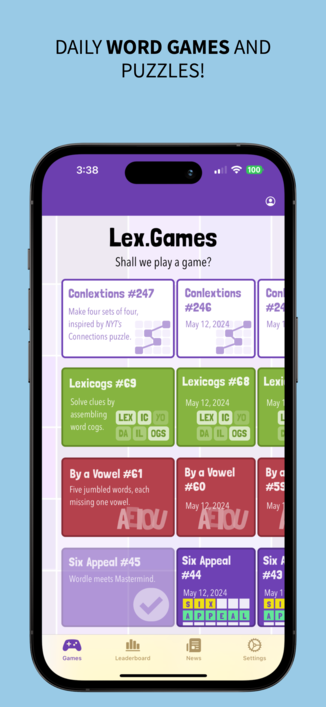
While I make Lex.Games freely available for most of the daily games, I charge a subscription for access to a few puzzles. I write nearly 3,000 puzzles a year to feed Lex.Games. That takes a lot of time. Subscribers pay me for some of that time. I’m grateful.
I released my terminal client LexShell for free, with exactly the features I needed. When folks wanted more features, I decided to make those an upsell, because… well, because they were hard to do, and required more time and testing and work.
Today, I actually launched subscriptions right here on Lex on Tech. This obviously isn’t an app. But I offered subscriptions here because I’m investing bucketloads of time into this site, and it’s nice to let folks who are willing to pay for that time do so. (Subscribers get full-text in RSS feeds, a new Lex on Tech podcast, a monthly zoom, the ability to post comments, and a few other perks. Mostly, they get to support me.)
Fee me, Seymour
My advice — to myself as much as you, dear reader — is to work on reshaping our mentalities towards subscriptions. Often, when I see a subscription available, I prefer to buy the lifetime version if one is available. If I think I’ll use an app for N years, and it works out to a savings for me to buy the app outright vs. pay the annual subscription fee for all those years, I’ll do so.
But increasingly… I don’t do so. Subscription fees offer developers guaranteed recurring revenue. (Well, usually guaranteed.) It’s hard to make a living on the App Store. If I did the math on my hourly rate for the time I’ve invested into my apps, based on my App Store earnings, well, let’s just say, I don’t do that math.
Subscription fatigue is real and it’s understandable. I’m trying, though, not to say to myself “Ugh, another subscription,” and instead say, “If I can get $5 or $10 or $20 of joy or utility out of this app per year, I am happy to pay that fee to the developer to make continued investment in the software worth their while.”
That’s a mouthful. But I do keep saying it to myself as new subscriptions crop up. I appreciate using apps ad-free; I appreciate apps that keep scoring updates and improvements. I appreciate apps that help me get more done, or that entertain me. I’m willing to pay for the privilege.
I do get sick of “the cost of a cup of coffee” analogies. I make my coffee at home. It works out to around 60¢ a cup most of the time on the high end, and often cheaper. I don’t buy overpriced coffee.
But I enjoy a nice dinner out with friends, even as restaurant prices continue to climb. If I’ve paid $50 or even $100 for my wife and me to enjoy a lovely evening with good people, that’s worth it to me, even though it “only” lasts a couple hours and then is but a memory. Framed that way, $20 a year for an app that I might spend many dozens of hours using makes a lot of sense to me.
Anyway, feel free to subscribe to Lex on Tech, which is free, but still. Subscriptions aren’t going anywhere — but the way we think about them still can change.