Running is gross. I can’t believe Matt Alexander likes running. I can’t believe anyone likes running. But Matt really, really does: He set 11 new personal bests in the first two weeks of November, and he plans to run two marathons in 2027 before he turns 40. He has also just released two health-centric iPhone and iPad apps, and he wrote up the story behind them.
If you’re the kind of person who runs on purpose, I guess there’s Breakfast. It reads your runs from Apple Health and shows you the heat maps, pace, heart rate, and splits for each one, plus your personal bests from 100 meters up to a marathon, the mileage on your shoes, and your trends over time. There’s no account, no built-in social network, and no tracking. Matt writes that he kept meeting runners who, like him, “were tired of bloated social experiences and expensive subscriptions,” so Breakfast has neither. It’s free on the App Store.
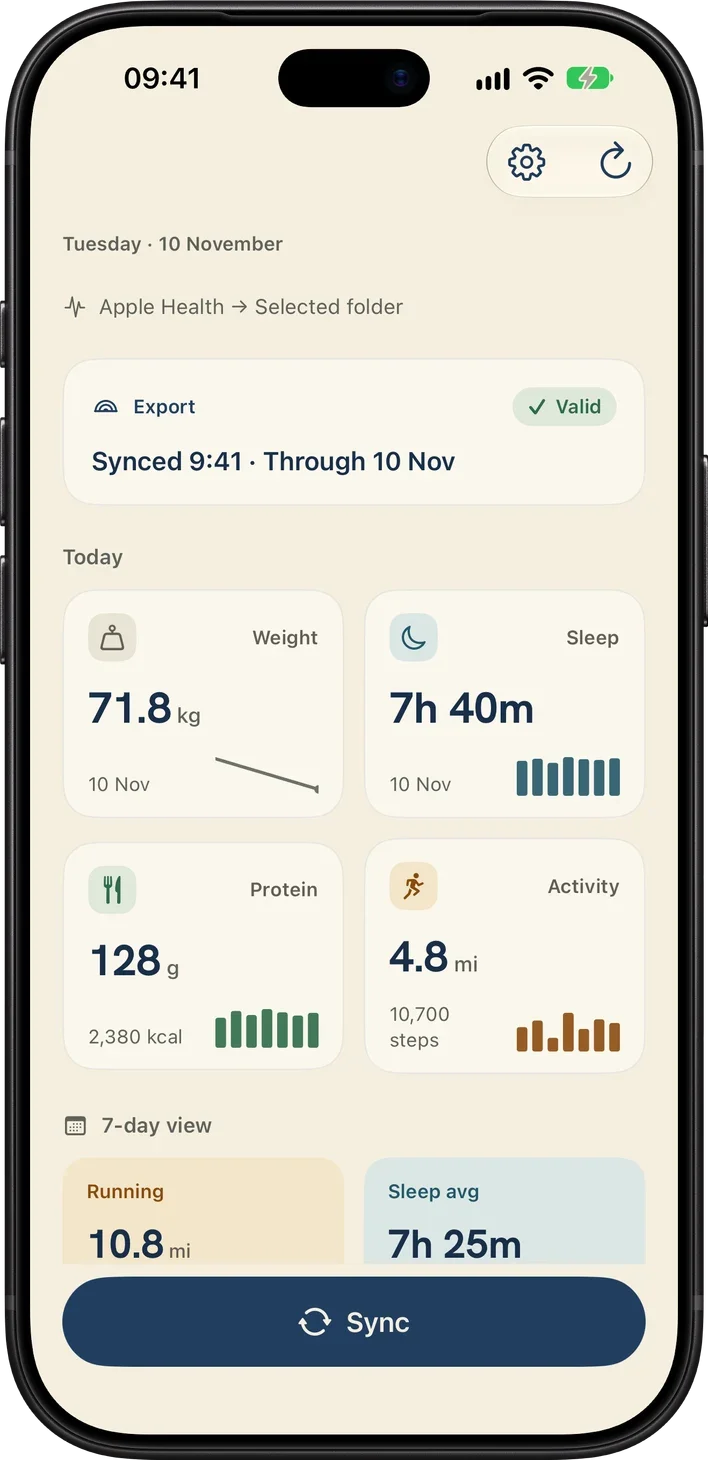
But I do care a lot about my health and my health data, so Matt’s second app, Daybreak, is the one for me. Daybreak exports your Apple Health history to plain JSON and CSV files, which you can keep on your device or in iCloud Drive. Matt built it because he wanted to talk through his trends with ChatGPT or a local LLM, but, as he puts it, “giving an AI service direct, ongoing access to Apple Health was something I was reluctant to do.”
With Daybreak, you decide which files go where. The app has no account, no ads, no analytics, and no server, and it makes no network requests of its own. It’s on the App Store for $1, and requires iOS 26 or later.
Matt is upfront that both apps were built with AI coding tools, “which conjures a lot of feelings.” I know those feelings well; I wrote about them in Claude writes code; I author the apps, and Matt writes: “Much like Lex, I’ve brought that perspective to the process to create something useful, modern, and lightweight.” He sketched interface ideas in his spare time over the summer, used Breakfast for his own running for months before anyone else saw it, and describes a year of effort and iteration. He didn’t even plan to publish either app. That’s what I mean by authoring: Matt made the apps he wanted, exactly the way he wanted them, and it shows.
The part of his post I admire most isn’t about the apps, though. In January 2022, Matt weighed 215 pounds. Today he’s around 140. He got there by giving himself permission to run very slowly, and by logging his weight, sleep, and workouts by hand in a Numbers spreadsheet every single day, until the averages mattered more to him than any one reading. “A ‘bad’ weigh-in used to totally derail me,” he writes. “Now, I understand the patterns.” I am a fan of weight-loss journeys, and I appreciate a healthy relationship with health data. Check out Breakfast and Daybreak. I’ll be using the one that doesn’t involve running.